
Why Some Buyers Are Choosing Boutique Living Over High Density Branded Condos in Estero
April 2, 2026 | Read Time: 5 minutes
A different way to evaluate condo living in Estero
There are lower-density alternatives to branded condominium developments in Estero, and for a growing segment of buyers, they represent a fundamentally different way to live.
As new branded towers complete construction and enter the market, they are drawing attention for their visibility and hospitality-driven environments. At the same time, they are prompting a more nuanced question from buyers, not simply which building is newest or most recognizable, but which living experience is actually preferable over time. The distinction is not subtle. It comes down to density, control, and how a residence functions on a daily basis.
How scale changes the living experience
Branded condominium developments are typically designed at scale. Larger residence counts, centralized amenities, and a service model influenced by hospitality all contribute to a more active environment. That model works for buyers who value energy, brand affiliation, and a resort-style atmosphere.
It also introduces trade-offs. As density increases, so does shared usage, operational complexity, and the overall pace of the building. Over time, the experience can begin to feel less residential and more like a destination.
What Defines a Boutique Residential Environment
Boutique residential communities are designed differently. They are not trying to accommodate volume. They are structured to support a more controlled, residential experience, fewer residences, more separation, and a quieter rhythm to daily life.
The focus shifts away from activity and toward livability. Space, privacy, and day-to-day comfort become the defining characteristics, not how many people the building can support.
Compare the Coastline
As more developments deliver across Southwest Florida, the range of options has expanded, but so has the complexity of evaluating them. For buyers, the challenge is no longer access to information. It is understanding how these properties actually compare in terms of density, livability, and long-term ownership.
Premier Sotheby’s International Realty has taken a more structured approach to that question. Through its “Compare the Coastline” initiative, the firm has developed a resource designed to help buyers evaluate new construction opportunities across the region with greater clarity. Rather than focusing on brand recognition or surface-level features, the platform looks more closely at how each property functions, how it is designed, and how it lives over time.
That perspective reflects what agents are seeing in the market.
“Buyers today are more analytical than they’ve been in the past,” said Adam Kaufman of Premier Sotheby’s International Realty. “They’re not just looking at what’s new or what’s branded. They’re evaluating how a property will live day to day, how it’s structured, and what the long-term experience will be. That’s where the real differences begin to show.”
The result is a more informed comparison—one that places developments with fundamentally different approaches side by side. In that context, the distinction between high-density, hospitality-driven buildings and more private, residential communities becomes easier to understand.
For buyers evaluating options in Estero and along the coast, this type of comparison provides a clearer framework for decision-making.
A More Private Approach at The Island at West Bay
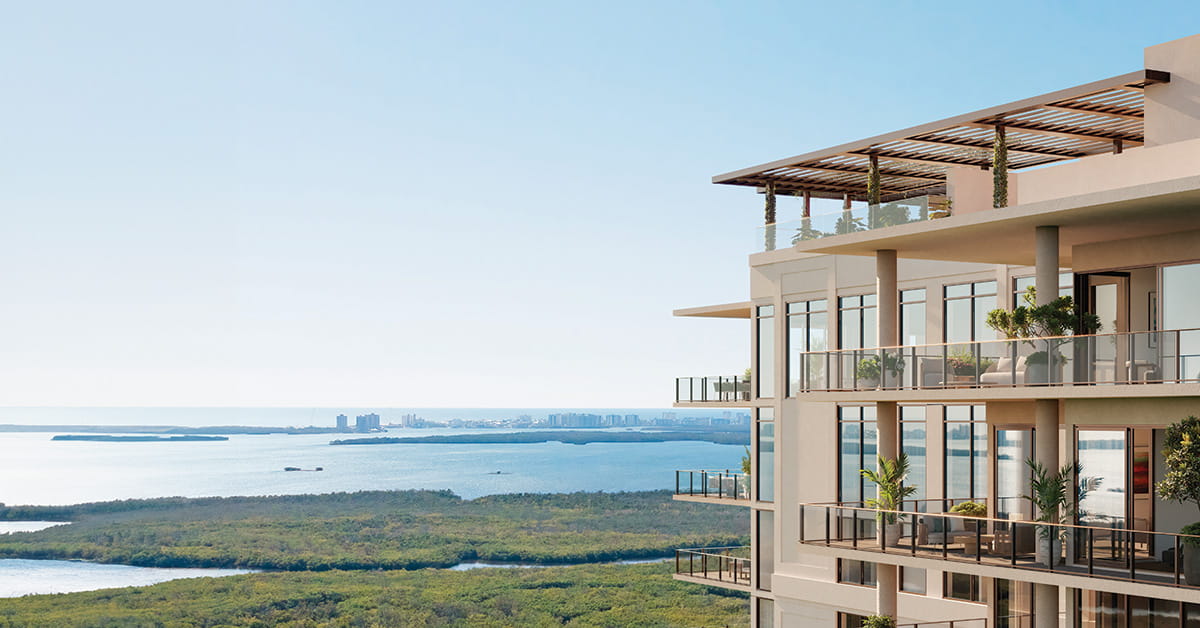
The Island at West Bay reflects this approach in a very specific way. The building is limited to 86 residences, with only four homes per floor. Every residence is positioned as a corner, eliminating interior units entirely.
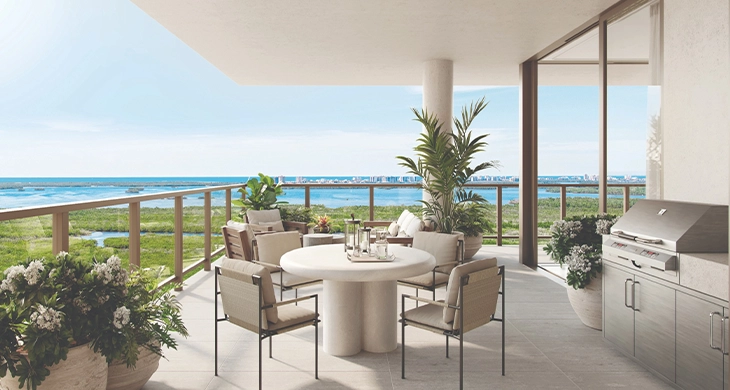
That configuration changes how the homes feel. Light enters from multiple directions, sightlines extend outward, and privacy is naturally reinforced by design rather than added as an afterthought.
The setting further defines the experience. Positioned within West Bay Club, the building operates within an established private environment rather than as a standalone destination. Residents move from a gated master-planned community into a more intimate residential setting, creating a layered sense of privacy that is difficult to replicate in larger developments.
Lifestyle that Feels Residential, Not Programmed
Lifestyle follows the same pattern. In higher-density buildings, amenities tend to concentrate activity and serve a broader population. Over time, they function that way.
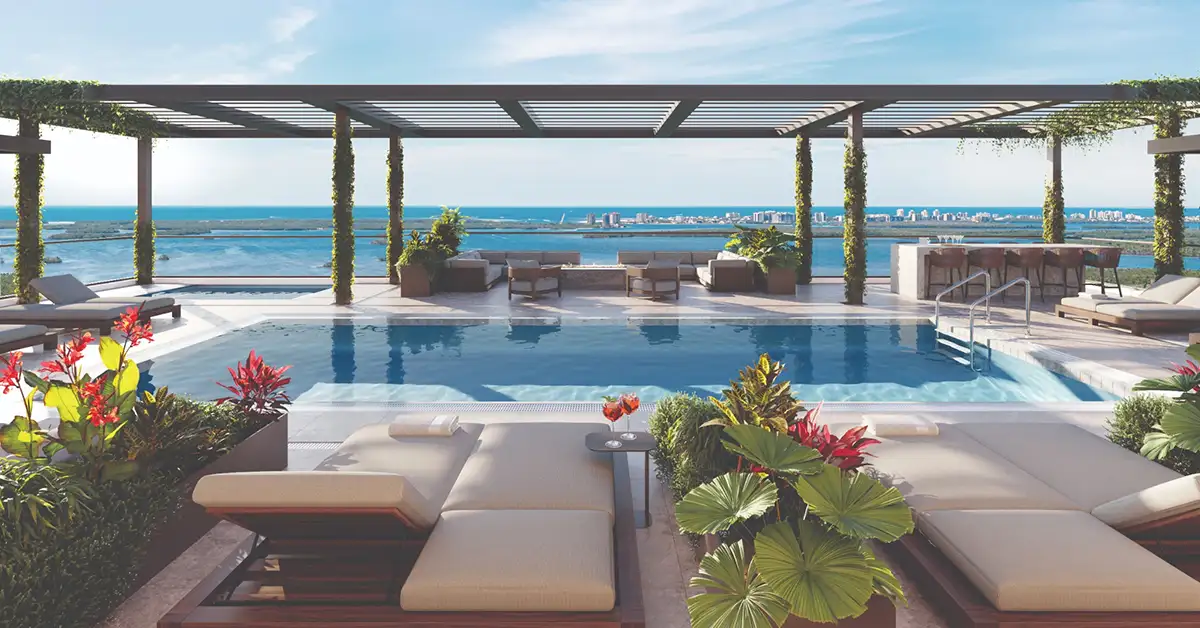
At The Island, amenities are distributed and scaled differently. There are private, on-property spaces that support daily routines, along with full access to West Bay Club, including a Gulf-front Beach Club, golf, dining, and wellness.
The experience is not built around constant activity. It allows residents to engage when they choose and step away when they don’t.
Looking Beyond Price to Long-term Livability
Another factor buyers are weighing more carefully is the cost of ownership over time.
In larger, high-density buildings, operating costs often reflect the scale of the property, the level of staffing, and the demands placed on shared amenities. Monthly obligations can increase alongside that complexity.
In a more controlled, lower-density environment, the structure is typically aligned with residential use rather than hospitality-level intensity. For buyers thinking long-term, this becomes part of the decision, not just the purchase price, but how the property lives financially over time.
A shift toward more intentional ownership
This is ultimately a question of alignment. Some buyers will continue to prioritize brand, scale, and visibility. Others are moving toward a different outcome, one defined by privacy, predictability, and a more personal living experience.
As the Estero market evolves, that distinction is becoming clearer. These are not variations of the same product. They are fundamentally different ways to live. To better understand how The Island at West Bay compares within the market, explore additional information through the project website, Premier Sotheby’s International Realty, or available comparison resources. Taking the time to evaluate these differences firsthand can provide a clearer understanding of which environment aligns with how you want to live.